
Running an ecommerce business is not just about uploading products, designing an attractive website, and waiting for customers to place orders. You might already have hundreds of products listed on your Shopify or WooCommerce store, but online sales may remain inconsistent despite investing money in Google Ads, Facebook Ads, and Instagram promotions. Some campaigns generate website visitors without purchases, while others attract orders that get cancelled, returned, or become unprofitable after advertising and delivery costs. These problems can make it difficult to understand where your marketing investment is actually going.
For ecommerce businesses in Vadodara, hiring the right performance marketing agency can help connect advertising, product visibility, website conversions, and customer acquisition with measurable sales outcomes. However, simply generating more traffic or increasing advertising expenditure will not necessarily grow your revenue. You need an agency that understands ecommerce platforms, product feeds, audience targeting, advertising creatives, conversion tracking, remarketing, and profitability. This guide explains how to select an ecommerce performance marketing agency in Vadodara, evaluate its capabilities, control advertising costs, and build campaigns that support sustainable online sales.
1. Why Does Your Ecommerce Store Need a Performance Marketing Agency?
An ecommerce performance marketing agency helps businesses attract relevant online shoppers, convert website visitors into customers, and measure the commercial results of advertising campaigns. Unlike general social media promotion, performance marketing focuses on measurable actions such as product purchases, revenue, customer acquisition costs, and return on advertising spend. It connects multiple activities, including Google Shopping, Search Ads, Facebook and Instagram campaigns, remarketing, landing-page optimization, and sales tracking.
Consider an ecommerce business in Vadodara selling home decor, fashion accessories, or consumer products across India. The store might receive regular website traffic from social media but generate very few completed purchases. The problem could be unrelated audiences, weak product images, unclear delivery information, unexpected shipping costs, or a complicated checkout experience. An experienced ecommerce marketing team should investigate these issues before recommending higher advertising budgets or launching additional campaigns.
Common Ecommerce Marketing Problems That Reduce Online Sales
Many online stores experience similar challenges, particularly when advertising activities are not connected to their website and sales data.
- Website traffic without purchases: Visitors browse product pages but leave without adding items to their carts or completing checkout.
- High advertising costs: Google and Meta campaigns consume substantial budgets without producing enough revenue or contribution margin.
- Poor audience targeting: Advertisements reach people who are interested in general product categories but are unlikely to purchase your actual products.
- Low product visibility: Product titles, descriptions, images, or catalog information are insufficient for effective Shopping campaigns.
- Cart abandonment: Customers add products to their carts but leave after encountering unexpected charges, limited payment options, or checkout difficulties.
- Unprofitable discount campaigns: Sales increase during promotions, but discounts and acquisition expenses leave very little margin.
- High order cancellations and returns: Advertisements generate orders, but a significant portion fails to become completed and retained sales.
- Weak repeat purchasing: The business spends money acquiring first-time customers without developing effective customer retention campaigns.
A performance marketing agency should identify which problems affect your store and prioritize solutions according to their potential commercial impact.
Understand the Difference Between Traffic Growth and Ecommerce Revenue
More website visitors do not automatically produce more orders. Your store needs a combination of relevant traffic, suitable products, competitive pricing, clear product information, customer trust, and a frictionless purchasing experience. For example, receiving 10,000 visitors from an audience interested in general fashion trends may be less valuable than receiving fewer visitors actively searching for the exact product your business sells.
Your agency should therefore evaluate the complete purchase journey. It should identify where visitors discover products, which product pages they view, how many add items to their carts, how many begin checkout, and how many eventually complete an order. These stages help determine whether the main problem is advertising relevance, product presentation, pricing, website experience, or checkout performance.
2. Which Ecommerce Performance Marketing Services Should You Look For?
A professional ecommerce performance marketing agency should provide services that work together to increase product sales and improve marketing efficiency. These services may include Google Ads, Google Shopping, Meta Ads, product feed management, remarketing, creative development, website conversion optimization, and ecommerce analytics. The combination depends on your product category, customer purchasing behaviour, average order value, available inventory, and target market.
For example, a Vadodara-based clothing store selling directly to Indian consumers may benefit from Instagram product demonstrations, Meta catalog campaigns, Google Shopping, and remarketing. A business selling specialized industrial products may need more search-focused campaigns and detailed product landing pages. Your agency should understand these differences and recommend channels according to customer demand rather than automatically allocating money to every available advertising platform.
Google Ads and Google Shopping for Ecommerce Products
Google Ads can help your store reach customers searching for specific products and brands. Search campaigns target relevant queries, while Shopping advertisements can display product information such as images, titles, and prices. Performance Max campaigns can also use a connected Google Merchant Center product feed to promote products across eligible Google advertising channels.
However, effective Shopping campaigns require accurate product information. Your product feed should contain relevant titles, descriptions, prices, availability, landing-page links, and product images. The information should match what customers see on the website. Google explains these requirements in its Merchant Center product data specifications.
An ecommerce agency should manage important activities such as:
- Product feed setup and optimization for Google Merchant Center.
- Product title and description improvements.
- Price and availability synchronization.
- Product approval and disapproval monitoring.
- Search keyword research and negative keyword management.
- Shopping and Performance Max campaign optimization.
- Product-level performance analysis.
Your agency should also explain which products deserve priority based on demand, stock availability, product margins, and historical sales performance.
Facebook and Instagram Ads for Product Discovery and Sales
Meta Ads can introduce products to relevant shoppers through Facebook and Instagram. These platforms are particularly useful for visually appealing products, new launches, seasonal collections, fashion, home accessories, beauty products, and lifestyle brands. Campaigns can use different audience strategies, product catalogs, videos, images, and remarketing approaches to encourage customers to explore and purchase products.
Your agency should understand how to develop advertising creatives that show the product clearly and communicate its practical value. For instance, a home furnishing store might use a product demonstration video, close-up images, customer usage scenarios, and collection-based advertisements. These creative variations can help identify which presentation attracts relevant customers and generates purchases rather than just likes or video views.
Ecommerce Website and Conversion Rate Optimization
Conversion Rate Optimization (CRO) involves improving your ecommerce website so a higher proportion of relevant visitors complete desired actions, especially purchases. It includes reviewing product-page layouts, navigation, images, descriptions, price presentation, delivery information, customer trust signals, mobile usability, cart functionality, and checkout steps.
A good agency should examine the website experience before recommending increased advertising expenditure. A campaign may attract customers at a reasonable cost, but a confusing checkout or missing delivery information can prevent those customers from completing orders. The agency should use analytics, customer behaviour, and structured testing to identify specific problems instead of making unsupported design changes.
Remarketing and Customer Retention Campaigns
Remarketing helps reconnect with eligible audiences who previously visited your store or interacted with your products. Customers may need more time to compare specifications, read reviews, check delivery conditions, or discuss a purchase before placing an order. Relevant remarketing messages can remind them about products they viewed or abandoned in their carts, subject to applicable advertising policies and consent requirements.
Customer retention marketing is equally important because existing customers may already understand your brand and products. Email, SMS, and WhatsApp marketing can support repeat purchases, product recommendations, replenishment reminders, and new product announcements when customers have provided the necessary permissions. A performance marketing agency should explain which activities support customer acquisition and which contribute to retention.
Build an Ecommerce Marketing Plan Around Your Products
Before selecting an agency, prepare your product categories, best-selling products, stock information, target locations, and sales objectives. Ask the agency to explain which platforms it recommends for each product category and why. A properly structured campaign plan should connect product visibility, creative strategy, website experience, and purchase tracking rather than treating advertising as an isolated activity.
3. How to Choose the Right Ecommerce Performance Marketing Agency in Vadodara
Selecting an ecommerce marketing agency requires evaluating its ability to manage online stores, understand product economics, and improve the complete customer purchasing journey. A general digital marketing agency may offer social media management and website promotion, but ecommerce advertising involves additional responsibilities such as product feeds, shopping campaign structures, catalog management, purchase tracking, inventory changes, and revenue attribution.
For example, an online retailer selling 500 products may not need equal advertising investment for every item. Some products might have stronger demand, better margins, fewer returns, or greater stock availability. An experienced ecommerce agency should know how to prioritize products and organize campaigns around commercial objectives. Its recommendations should reflect the store's actual sales and product data, not simply the number of products listed on the website.
Evaluate the Agency's Ecommerce Platform Experience
Check whether the agency has experience working with the ecommerce platform your business uses. Shopify, WooCommerce, and other ecommerce solutions have different administration systems, integrations, themes, checkout configurations, and tracking requirements. The agency does not necessarily need to be a website development company, but it should understand how your store's technical setup affects advertising and purchase measurement.
Ask whether its team can work with:
- Shopify: Product catalogs, collections, product variants, checkout events, advertising integrations, and ecommerce analytics.
- WooCommerce: Product synchronization, WordPress integrations, order tracking, product feeds, and plugin compatibility.
- Custom ecommerce websites: Website event implementation, product catalog integration, checkout tracking, and technical coordination with developers.
- Marketplace stores: Amazon, Flipkart, and other marketplace advertising or management, when these platforms form part of your sales strategy.
Request examples of campaigns managed on a similar platform. The agency should explain its role in those projects and the particular challenges it handled.
Review Ecommerce Case Studies and Previous Campaign Results
Ask for evidence demonstrating how the agency has supported online stores. A useful case study should explain the store's starting position, product category, advertising objectives, campaign structure, conversion measurement, and outcomes. Look for evidence about actual purchases, advertising costs, revenue, customer acquisition, and profitability rather than relying entirely on impressions or website traffic.
Ask specific questions about previous projects:
- What ecommerce product category did the client sell?
- Which advertising platforms were used?
- How was the product catalog managed?
- Which conversions were tracked?
- How were advertising results compared with actual store orders?
- How did the agency deal with cancellations and returns?
- Which campaign changes improved performance?
- What limitations affected the results?
An agency may be unable to disclose client names or confidential account data. In that situation, request anonymized reporting examples or a clear explanation of its measurement methodology. Do not assume that a case study from a different industry guarantees similar results for your store.
Check the Agency's Ecommerce Advertising Team
Understand who will manage your campaigns and which specialists will support the work. An ecommerce growth engagement may require advertising managers, creative designers, copywriters, analytics specialists, and website developers. Smaller agencies may assign several responsibilities to one person, which can work well when roles and workload are clearly explained.
During your initial meeting, establish who will handle account optimization, product feed issues, creative approval, reporting, and technical implementation. Ask how frequently you will receive updates and whether you can speak directly with the campaign manager. Consistent communication helps identify issues such as stock shortages, changing product prices, seasonal demand, and customer complaints before they affect campaign performance.
Compare Local Agencies Based on Capability, Not Office Location Alone
Working with an agency in Vadodara can make meetings, product discussions, and coordination convenient. However, local presence should be only one part of your decision. A strong remote agency may also be suitable if it understands your target market, ecommerce platform, advertising requirements, and business economics.
Compare agencies using the following criteria:
| Evaluation factor | What to examine | Why it matters |
|---|---|---|
| Ecommerce experience | Similar product categories and platforms | Determines industry and platform understanding |
| Google Ads | Search, Shopping, and Performance Max | Supports high-intent product discovery |
| Meta Ads | Catalog, creative, and remarketing campaigns | Supports product discovery and consideration |
| Product feed management | Merchant Center setup and feed maintenance | Helps products qualify for relevant listings |
| Conversion tracking | Purchase events, order values, and attribution | Measures actual ecommerce activity |
| CRO expertise | Product pages, carts, and checkout experience | Helps reduce unnecessary purchase friction |
| Reporting | Revenue, ROAS, margins, and customer acquisition | Connects advertising with business outcomes |
| Account ownership | Administrative access and data control | Protects your business assets |
A practical comparison should also consider communication, contract terms, pricing transparency, and the ability to coordinate with your internal ecommerce team.
4. How Can Google Ads and Meta Ads Increase Your Ecommerce Sales?
Google Ads and Meta Ads can support different stages of the online purchasing journey. Google advertising can reach shoppers who actively search for products, while Meta advertising can create product awareness, demonstrate benefits, and encourage purchases from relevant audiences. Combining these channels can help ecommerce brands reach customers through multiple interactions, but the correct channel mix depends on product demand, purchasing behaviour, competition, and budget.
Consider a hypothetical Vadodara business selling premium kitchen appliances across India. Google Search and Shopping campaigns may capture people actively comparing specific appliance models. Instagram and Facebook campaigns could introduce new products through demonstrations, lifestyle images, and promotional collections. Remarketing could then reconnect with eligible visitors who viewed those products but did not purchase. The agency should measure the contribution of each channel without automatically crediting every sale to the last advertisement.
Use Search Intent to Attract Customers Ready to Purchase
Search intent helps determine what a person expects when entering a particular query into Google. Someone searching for a specific product model may have a stronger purchase requirement than someone searching for general product information. An ecommerce agency should research product keywords and separate them according to customer needs, product categories, brand searches, and buying stages.
For example, a business selling office chairs could consider different keyword groups, such as ergonomic office chairs, adjustable office chairs, office chairs under a specific budget, and its own branded product searches. Each group may require different advertisements and landing pages. Your agency should also review actual search terms to identify irrelevant traffic and add suitable negative keywords where appropriate.
Use Meta Creative Testing to Discover What Encourages Purchases
Your product advertisement should show customers what they are buying and why it may be suitable for their needs. Images, videos, demonstrations, product comparisons, and customer-generated content can communicate product value in different ways. However, creative performance must be evaluated using purchase-related results rather than engagement alone.
A useful creative testing process might include:
- Product-focused images that clearly show the item and its distinguishing features.
- Demonstration videos explaining how the product works.
- Lifestyle creatives showing realistic product usage.
- Collection advertisements highlighting related products.
- Offer-based advertisements with accurate prices and conditions.
- Customer review or testimonial creatives when genuine permission and evidence are available.
The agency should test different creative approaches and compare their contribution to purchases, average order value, and advertising efficiency.
Use Google Performance Max and Product Feed Optimization
Performance Max is a Google Ads campaign type that uses Google's automation across eligible Google advertising inventory. For ecommerce retailers, Merchant Center product feeds provide information that can help advertise individual products. Google's official Performance Max optimization guidance for retailers recommends improving product data, maintaining current prices and availability, using suitable creative assets, and measuring conversion values.
Your agency should not treat Performance Max as a campaign that can simply be switched on and ignored. It should monitor product approvals, feed quality, conversion tracking, asset performance, and purchase values. Product categories with different margins or priorities may also need different measurement and campaign decisions.
Use Remarketing to Recover Potentially Lost Purchases
Some customers leave an ecommerce website because they are comparing alternatives or waiting for a suitable time to purchase. Remarketing can help bring eligible visitors back with relevant advertisements, provided the business respects advertising consent and platform requirements. For example, someone who viewed a particular footwear collection may respond better to a relevant product reminder than a generic advertisement for the entire store.
However, repeated advertising does not guarantee a recovered sale. Your agency should control audience exclusions, frequency where supported, purchase-based suppression, and remarketing windows. Customers who have already completed a purchase should not continue seeing advertisements designed only for first-time buyers unless there is a genuine cross-selling or repeat-purchase objective.
Request a Channel-Wise Ecommerce Advertising Strategy
Ask the agency to explain how Google Search, Shopping, Performance Max, Facebook, Instagram, and remarketing could support your specific product categories. The proposal should identify each channel's purpose, budget allocation, creative requirements, and measurement method. This will help you understand why your money is being spent and which campaigns are responsible for different parts of the purchasing journey.
5. Which Ecommerce Metrics Should Your Performance Marketing Agency Track?
Your agency should evaluate ecommerce campaigns using metrics that connect advertising expenditure with completed sales, revenue, customer acquisition costs, and product profitability. Impressions and clicks are useful for understanding campaign delivery, but they do not establish whether the business is making money. A store needs accurate purchase tracking and an understanding of the costs involved in delivering an order before deciding whether a campaign is successful.
For example, two campaigns may each generate ₹1,00,000 in recorded revenue, but their business value can differ considerably. One campaign may sell products with strong contribution margins and low return rates, while another may generate orders with high discounting, shipping costs, and cancellations. Your agency should help you evaluate the actual economic value of sales rather than presenting revenue as the only measure of success.
Important Ecommerce Performance Marketing KPIs
The following metrics provide a practical framework for reviewing advertising and store performance.
| KPI | Meaning | How It Helps |
|---|---|---|
| Click-through rate (CTR) | Percentage of ad impressions that result in clicks | Evaluates advertisement relevance |
| Cost per click (CPC) | Average cost of receiving an advertisement click | Measures traffic acquisition expense |
| Conversion rate | Percentage of relevant visitors who complete a purchase | Evaluates the buying journey |
| Average order value (AOV) | Average revenue per order | Helps understand order economics |
| Cost per acquisition (CPA) | Advertising cost per acquired purchase | Measures customer acquisition expense |
| Return on ad spend (ROAS) | Attributed revenue divided by advertising expenditure | Measures reported advertising efficiency |
| Customer acquisition cost (CAC) | Total relevant acquisition expenditure per new customer | Evaluates broader acquisition economics |
| Cart abandonment rate | Percentage of initiated carts that do not become completed purchases | Identifies potential checkout losses |
| Repeat purchase rate | Proportion of customers who purchase again | Helps evaluate retention |
| Return and cancellation rate | Share of orders cancelled or returned | Shows the quality of completed sales |
Different metrics have different uses. Your agency should explain which ones are appropriate for your store, how they are calculated, and whether they are measured using advertising platforms, analytics systems, or actual ecommerce order records.
Understand ROAS and Why a High Number May Still Be Unprofitable
Return on Ad Spend (ROAS) is calculated by dividing advertising-attributed revenue by advertising expenditure. If a campaign spends ₹20,000 and records ₹1,00,000 in attributed revenue, its reported ROAS is 5x. This means the campaign generated ₹5 in attributed sales revenue for every ₹1 spent on advertising, but it does not mean the business earned ₹5 in profit.
The business must also account for product costs, discounts, payment processing, packaging, fulfilment, shipping subsidies, returns, and other relevant variable expenses. The resulting contribution margin determines how much money remains to cover advertising and fixed business costs.
Calculate Your Break-Even ROAS Before Increasing the Advertising Budget
Break-even ROAS helps you understand the advertising efficiency required to cover the variable costs of selling a product. A simplified formula is:
Break-even ROAS = 1 ÷ Contribution Margin Percentage
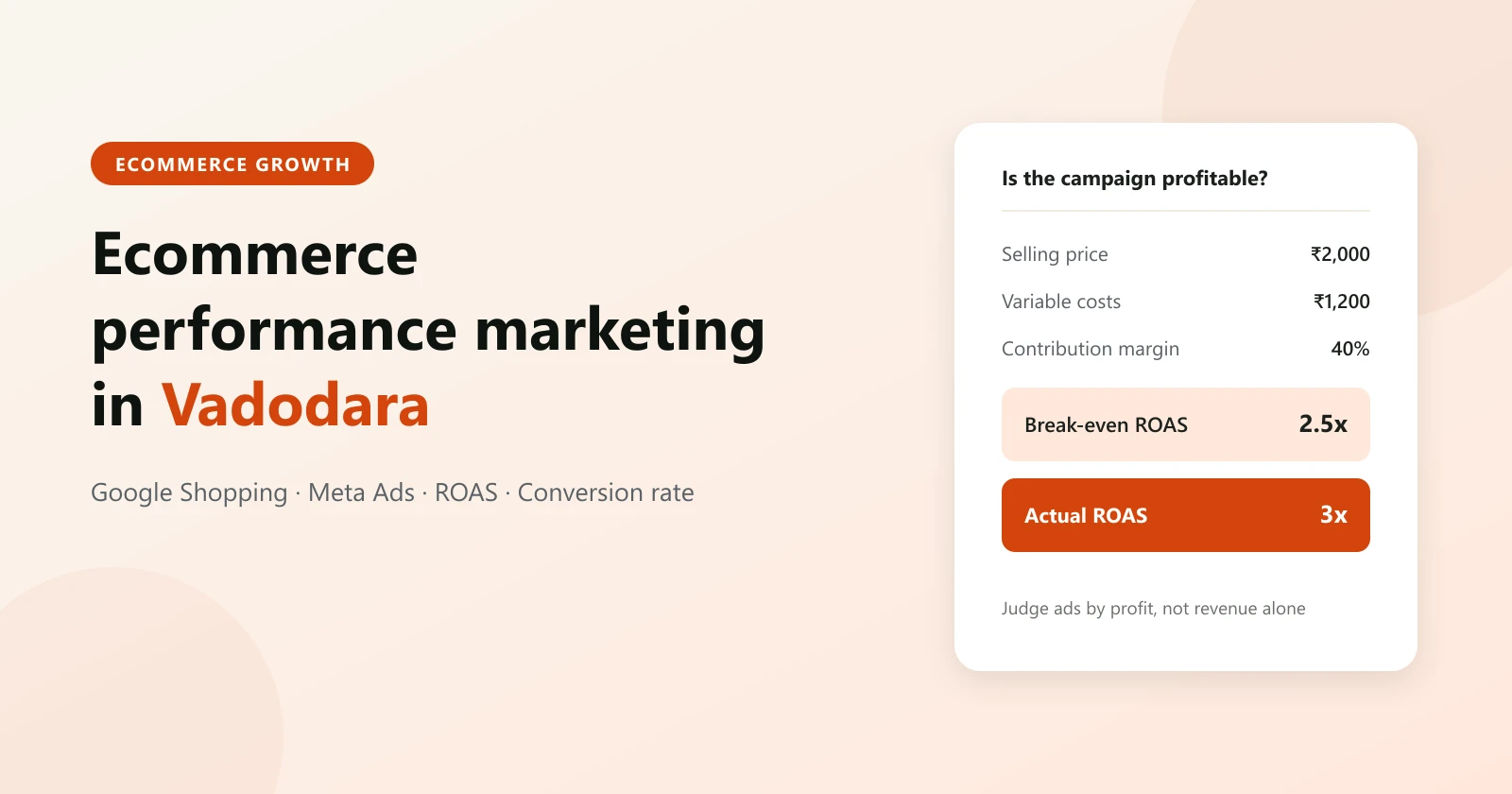
Suppose your ecommerce store sells a product for ₹2,000 and has ₹1,200 in variable costs before advertising. The remaining ₹800 represents a 40% contribution margin. The break-even ROAS is therefore 2.5x, before fixed overheads and any additional costs not included in that calculation.
| Business measurement | Hypothetical amount |
|---|---|
| Selling price | ₹2,000 |
| Product and other variable costs | ₹1,200 |
| Contribution before advertising | ₹800 |
| Contribution margin | 40% |
| Break-even ROAS | 2.5x |
| Actual campaign ROAS | 3x |
| Advertising cost per order | Approximately ₹666.67 |
| Contribution remaining after advertising | Approximately ₹133.33 |
This example assumes the sale is retained and the listed variable costs are complete. Actual profitability may be lower when returns, cancellations, overheads, or additional charges are included. Each product category may therefore require a different target rather than one ROAS target for the entire store.
Measure Customer Acquisition and Repeat Purchase Value
The first purchase is not always the complete measure of a customer relationship. Some ecommerce businesses sell products that customers purchase regularly, while others sell products with a much longer replacement cycle. Your marketing team should understand the distinction because a campaign that initially acquires customers at a higher cost may still become commercially valuable when repeat purchases are considered.
Ask your agency to distinguish new customers from returning customers wherever your analytics and order data allow. Review repeat purchases, revenue by customer cohort, average order value, and the contribution generated over time. Do not use estimated lifetime customer value as guaranteed revenue; base important decisions on observed customer behaviour and clearly stated assumptions.
6. How to Optimize Your Ecommerce Website to Convert More Visitors Into Buyers
Your ecommerce website is one of the most important parts of your advertising strategy because it is where online shoppers evaluate products and complete purchases. A campaign may attract relevant customers at a reasonable cost, but product-page problems, slow loading, unclear delivery information, missing trust signals, and complicated checkouts can prevent those visitors from ordering. Your agency should therefore evaluate website conversion performance alongside advertising campaigns.
Imagine a customer clicking an advertisement for a premium handbag. The product image looks attractive, but the landing page has incomplete product details, unclear return conditions, and no visible delivery estimate. The customer may leave the store and search for a competing brand. Improving the advertisement alone will not solve this problem. The store must provide enough relevant information to help the customer make a confident purchasing decision.
Improve Product Pages With Clear Information and Better Images
A product page should answer the shopper's main questions without forcing them to search multiple pages. The product title, images, descriptions, specifications, sizes, materials, colour options, availability, price, delivery information, and return conditions should be presented accurately. Product information must also remain consistent with the information used in advertising feeds.
For example, a clothing store should provide useful size information, multiple product views, material details, and care instructions. A furniture store may need dimensions, assembly information, available finishes, and delivery restrictions. Your agency should identify missing product information that could affect customer confidence or create mismatches between advertisements and the actual product.
Make the Checkout Process Easier for Mobile Shoppers
Many shoppers browse and purchase products using mobile devices. A checkout that requires unnecessary steps, confusing form fields, repeated information, or difficult payment navigation can discourage completion. Your agency should review the checkout process using real devices and test the complete purchasing journey rather than relying only on desktop screenshots.
Check the following areas:
- Mobile product-page readability and navigation.
- Product variant selection and quantity controls.
- Cart visibility and order summary.
- Transparent shipping charges and delivery timelines.
- Available payment methods and payment confirmation.
- Clear return, refund, and cancellation information.
- Error handling and confirmation after a successful purchase.
Changes should be prioritized using analytics and user testing. Reducing checkout fields may help some stores, while other stores may need better delivery information or clearer product options first.
Build Customer Trust Before the Purchase Decision
Online customers cannot physically inspect products before ordering. Your store must therefore provide accurate descriptions, authentic images, transparent policies, and reliable customer communication. Genuine reviews, verified product details, business contact information, and clear return procedures can help shoppers understand what to expect.
An agency should avoid adding unsupported trust claims or fabricated reviews to improve conversion rates. Instead, it should identify where actual customer information and business policies can be presented more clearly. For ecommerce brands selling higher-value products, providing product demonstrations, warranty details, payment information, and detailed FAQs may be especially helpful.
Optimize Website Speed and Shopping Experience
Website performance can influence how easily customers browse product categories, view images, add products to carts, and complete orders. Large images, excessive scripts, poorly configured plugins, and unnecessary third-party integrations may affect performance. Your agency should coordinate with your development team to identify technical issues and assess their impact on the purchasing experience.
Use tools such as Google PageSpeed Insights and Google Search Console to investigate relevant website performance and search issues. Do not treat a single performance score as proof that a store is losing sales. Review actual device behaviour, page loading problems, and conversion data to determine which improvements deserve priority.
Ask for a Conversion Audit Before Spending More on Ads
Request an assessment of your most important product pages, category pages, mobile experience, cart, and checkout. The agency should identify specific improvements and explain how their effect will be measured. Fixing a critical website problem can be more valuable than paying to send additional visitors into a buying journey that does not convert.
7. How Much Should You Invest in Ecommerce Performance Marketing?
Your ecommerce advertising budget should be based on product margins, customer acquisition targets, available inventory, average order value, competition, and the store's ability to process additional orders. There is no universally correct budget for every ecommerce business in Vadodara. A small store testing a limited product range has different financial requirements from a growing brand selling hundreds of products across multiple categories and customer segments.
Before approving a budget, separate advertising expenditure from agency fees, creative production, website development, and technology costs. A business that allocates its entire marketing budget to advertisements may have insufficient resources for product photography, feed maintenance, analytics, or checkout improvements. A realistic investment plan should cover the complete activities needed to acquire and serve customers profitably.
Understand the Main Costs of Ecommerce Advertising
Your monthly expenditure may include several components depending on the agency's proposal and your store's requirements.
| Cost component | What It Covers | Budget Consideration |
|---|---|---|
| Google Ads spend | Search, Shopping, and Performance Max | Direct advertising expenditure |
| Meta Ads spend | Facebook and Instagram campaigns | Direct advertising expenditure |
| Agency management fee | Strategy, setup, optimization, and reporting | Professional service cost |
| Creative production | Product images, videos, copy, and design | Depends on creative volume |
| Product feed management | Catalog setup and ongoing updates | Depends on product count and complexity |
| Website development | Landing-page and checkout improvements | May involve separate project charges |
| Analytics and tracking | Purchase events and reporting integration | Setup and maintenance requirements |
| CRM and retention tools | Customer communication and automation | Software and implementation costs |
Ask the agency to clarify which activities are included in its management fee and which will require additional expenditure. This prevents disagreements when technical work, creative revisions, or new campaigns become necessary.
Start With a Controlled Advertising Test
A controlled test allows your business to evaluate audience response, product demand, creative performance, and purchase tracking without committing to an unnecessarily large initial budget. Select products that have suitable margins, adequate inventory, competitive pricing, and clear product information. Then define the campaign objectives and the results required before expanding expenditure.
For example, a store could test a limited range of high-priority products using selected Google and Meta campaigns. It should compare the resulting purchases with advertising expenditure and actual order economics. The test should have enough time and conversion data to support meaningful decisions, while the agency should investigate tracking or campaign delivery problems as soon as they appear.
Allocate Budget According to Product Performance
Not all products deserve equal advertising investment. Your best-selling product may have strong demand but a lower margin, while a newer product may offer better margins but require more customer education. The agency should examine demand, profitability, stock availability, purchase behaviour, and competitive conditions before assigning product-level advertising priorities.
A useful product classification could include:
- Best-selling products: Products with established sales demand and sufficient inventory.
- High-margin products: Products that offer more contribution toward acquisition and operating costs.
- New product launches: Items requiring awareness, testing, and customer feedback.
- Seasonal products: Items whose demand depends on specific events or purchasing periods.
- Slow-moving inventory: Products that may need targeted offers or different positioning, subject to margin and stock considerations.
Monitor performance by product and category rather than allowing a few successful products to hide weaker campaign performance across the store.
Know When to Increase or Reduce Your Advertising Budget
Increase expenditure when campaign tracking is reliable, purchase quality is understood, product margins support acquisition costs, and inventory and fulfilment can handle additional demand. A campaign showing strong ROAS for a short period may not remain equally effective when the budget increases or the audience expands.
Reduce, pause, or restructure spending when tracking becomes unreliable, product availability changes, advertising costs exceed sustainable levels, or order quality deteriorates. Your agency should explain the reason for budget changes and provide supporting data. Scaling should follow evidence about commercial performance rather than an arbitrary target for monthly advertising expenditure.
8. Red Flags to Avoid When Hiring an Ecommerce Performance Marketing Agency
Not every agency that offers Google Ads, Facebook Ads, or ecommerce marketing has the technical and commercial knowledge needed to support an online store. Before signing an agreement, evaluate how the provider approaches product data, conversion measurement, campaign ownership, creative testing, profitability, and reporting. The agency should understand that an ecommerce purchase is more than a click or a form submission and that the business must earn enough from the order to cover its costs.
A provider promising guaranteed sales or extremely high ROAS without understanding your products, margins, advertising history, and target customers deserves additional scrutiny. Advertising outcomes depend on multiple factors, including demand, competition, pricing, inventory, website experience, and customer behaviour. A responsible agency should explain what it can control, which business conditions affect performance, and how results will be evaluated.
Warning Signs That Indicate an Agency May Not Be Suitable
Watch for these common problems before selecting an ecommerce marketing partner.
- Guaranteed sales and ROAS: Be cautious of fixed sales or profitability promises unsupported by your store's historical performance and economics.
- No product feed knowledge: An agency managing Shopping campaigns should understand Merchant Center, product attributes, feed errors, and product approvals.
- No purchase tracking: Campaigns should distinguish genuine completed purchases from add-to-cart actions or other preliminary events.
- Only traffic and engagement reports: Website visits, likes, and impressions cannot independently demonstrate profitable ecommerce performance.
- No product-level analysis: Reporting only overall account ROAS can hide products that are consuming budget without producing sufficient contribution.
- Unclear account ownership: Your business should retain access to its advertising accounts, analytics, product data, and creative assets.
- No website conversion analysis: An agency should be willing to investigate checkout, product-page, and mobile usability problems.
- No discussion about returns or cancellations: In businesses with meaningful cancellations, returns, or undelivered orders, ignoring those outcomes can distort campaign decisions.
Also examine whether the agency communicates clearly when results are poor. A good provider should discuss problems openly and provide a practical improvement plan rather than continuously asking for a larger advertising budget.
Questions to Ask Before Signing an Ecommerce Marketing Contract
Use your first agency meeting to understand the provider's working process and technical responsibilities.
- Have you managed ecommerce stores similar to mine?
- Which products and platforms have you worked with?
- Can you manage Google Merchant Center and product feed optimization?
- How do you track completed purchases and their revenue values?
- Can you distinguish new customers from returning customers?
- How do you calculate ROAS and evaluate product profitability?
- How will you handle stock changes and unavailable products?
- What is included in the monthly management fee?
- Who owns the advertising accounts and customer data?
- How frequently will we review sales, campaign results, and next steps?
The quality of the answers matters more than the number of services listed in a proposal. Ask the agency to demonstrate its approach using a practical example related to your store.
A Practical 30-Day Ecommerce Agency Evaluation Framework
A structured first-month evaluation can help establish whether your agency understands your business and can manage the advertising process effectively. The following framework is a suggested starting point. Campaign outcomes may take longer to evaluate depending on sales volume, customer buying cycles, and available tracking data.
Week 1: Ecommerce Store and Business Audit
The agency should review your products, categories, selling prices, margins, inventory, website platform, advertising history, and existing customer data. It should examine product-page quality, mobile performance, cart and checkout experience, and the current tracking setup. The outcome should be a documented list of issues and priorities.
Week 2: Campaign and Tracking Setup
Prepare campaign structures, product feed improvements, advertising creatives, audience strategies, and conversion tracking. Test purchase events and transaction values against actual store orders. Review whether your key products meet Merchant Center requirements and whether prices and inventory information are accurate.
Week 3: Campaign Monitoring and Optimization
Examine campaign delivery, search queries, product performance, advertisement engagement, and initial purchases. Identify products that attract visitors but do not convert, and investigate whether the reasons involve targeting, price, product information, or the website experience. Make controlled changes based on the available evidence.
Week 4: Ecommerce Sales and Profitability Review
Review advertising costs, attributed revenue, purchase numbers, average order value, product margins, and relevant cancellation or return information. Compare the marketing dashboard with actual store orders and payment records. The agency should explain which campaigns deserve continued testing, which products need improvement, and whether the next budget allocation is commercially sensible.
Start With a Clearly Defined Ecommerce Growth Engagement
Before signing a longer agreement, request a written scope covering campaign management, product feeds, creative development, tracking, reporting, and website support. Define how sales and profitability will be reviewed, who owns the accounts, and how both teams will communicate. A clearly structured engagement helps your business evaluate the agency using evidence rather than unsupported promises.
Frequently Asked Questions About Ecommerce Performance Marketing Agencies in Vadodara
1. How Do I Find the Best Ecommerce Performance Marketing Agency in Vadodara?
Start by looking for agencies with practical ecommerce experience, particularly in your product category and website platform. Review their Google Ads, Meta Ads, Merchant Center, product feed, and purchase tracking capabilities. Ask for examples of previous campaigns and understand how they measure completed orders, revenue, and customer acquisition costs. Compare proposals based on technical capabilities, communication, reporting, and business understanding rather than selecting an agency only because of its location or low fees.
2. How Much Does an Ecommerce Performance Marketing Agency Charge in Vadodara?
The cost depends on the number of products, advertising platforms, campaign complexity, creative requirements, product feed management, and reporting responsibilities. Most proposals should separately identify advertising expenditure and professional management fees. Website development, tracking integration, and creative production may also be charged separately. Request a detailed quotation that explains the services included, additional costs, contract duration, and ownership of advertising accounts before committing to an agency.
3. Which Is Better for Ecommerce Sales: Google Ads or Facebook Ads?
Neither platform is universally better because they serve different customer behaviours. Google Ads can connect your products with people actively searching for them, while Facebook and Instagram advertising can introduce products to relevant audiences through visual content and creative campaigns. Many ecommerce businesses benefit from using both, provided the channel allocation reflects product demand, margins, audience behaviour, and available budget. Compare their contribution using completed purchases and commercial results rather than engagement alone.
4. Can a Performance Marketing Agency Help Increase Shopify and WooCommerce Sales?
Yes. An experienced ecommerce agency can support Shopify and WooCommerce stores through advertising strategy, product feed management, Google Shopping, Meta catalog campaigns, remarketing, and conversion tracking. It can also identify problems with product pages, cart functionality, mobile experience, and checkout. The exact work depends on your website configuration and technical requirements. Ask the agency to explain how it will connect advertising activity with actual purchases recorded in your ecommerce platform.
5. What Is a Good ROAS for an Ecommerce Business?
A suitable ROAS depends on your contribution margin, order value, product costs, discounts, shipping, payment processing, fulfilment, and returns. A business with a higher contribution margin can generally support a lower break-even ROAS than one with very thin margins. Instead of copying another company's ROAS target, calculate your own break-even point and establish a target that also accounts for fixed operating expenses and the profitability required by your business.
6. How Long Does It Take to Increase Online Sales Through Performance Marketing?
Advertising can begin generating website visits and purchase data shortly after launch, but sustainable improvements may take longer. The timeline depends on product demand, budget, competition, conversion tracking, website quality, and how quickly customers make purchasing decisions. An agency should establish measurement milestones and continuously review campaign performance. It should not promise a guaranteed sales increase within a fixed number of days without considering your store's actual starting position.
7. Why Are My Ecommerce Ads Getting Clicks but Not Generating Orders?
Clicks without purchases may indicate a mismatch between the advertisement and the product page, incorrect audience targeting, uncompetitive pricing, missing product information, unexpected shipping costs, weak customer trust, or checkout problems. Start by comparing landing-page visits, product views, add-to-cart activity, checkout initiation, and completed purchases. This helps identify where customers leave the buying journey. Your agency should investigate the specific problem before recommending increased advertising expenditure.
8. Should an Ecommerce Business Hire an Agency or Manage Google and Meta Ads In-House?
Managing campaigns internally may work when your business has experienced advertising professionals, sufficient time, and the technical resources needed for tracking and optimization. An external agency may be more suitable when you need specialized expertise in Shopping campaigns, product feeds, advertising creative, analytics, and conversion optimization. Compare the full cost of both approaches, including staff time, software, creative production, and technical support. Choose the model that gives your business the strongest combination of expertise, transparency, and commercial control.
Conclusion: Choose an Ecommerce Marketing Agency That Focuses on Profitable Online Sales
Hiring an ecommerce performance marketing agency in Vadodara should be a business decision based on your store's actual growth requirements. Your ideal agency should understand Google Ads, Meta Ads, Merchant Center, product feeds, ecommerce platforms, website conversion optimization, remarketing, and purchase tracking. More importantly, it should understand the economics behind your products. Advertising revenue, ROAS, and order volume need to be evaluated alongside product margins, discounts, shipping, fulfilment, returns, and customer acquisition costs to determine whether your marketing investment is supporting profitable growth.
Before selecting an agency, assess your existing ecommerce performance, identify the products that deserve greater attention, and establish realistic advertising objectives. Request a detailed store and advertising audit, compare agency capabilities, and agree on transparent reporting and account ownership. The right marketing partner should help you understand which channels attract customers, which products generate valuable orders, where your website loses potential buyers, and how your business can improve its online sales without relying on unnecessary advertising expenditure.
See exactly where ChatGPT, Gemini & Perplexity mention your brand
Our senior search architects forensic-test 50+ commercial buying queries to uncover your brand's true generative visibility against top competitors.