
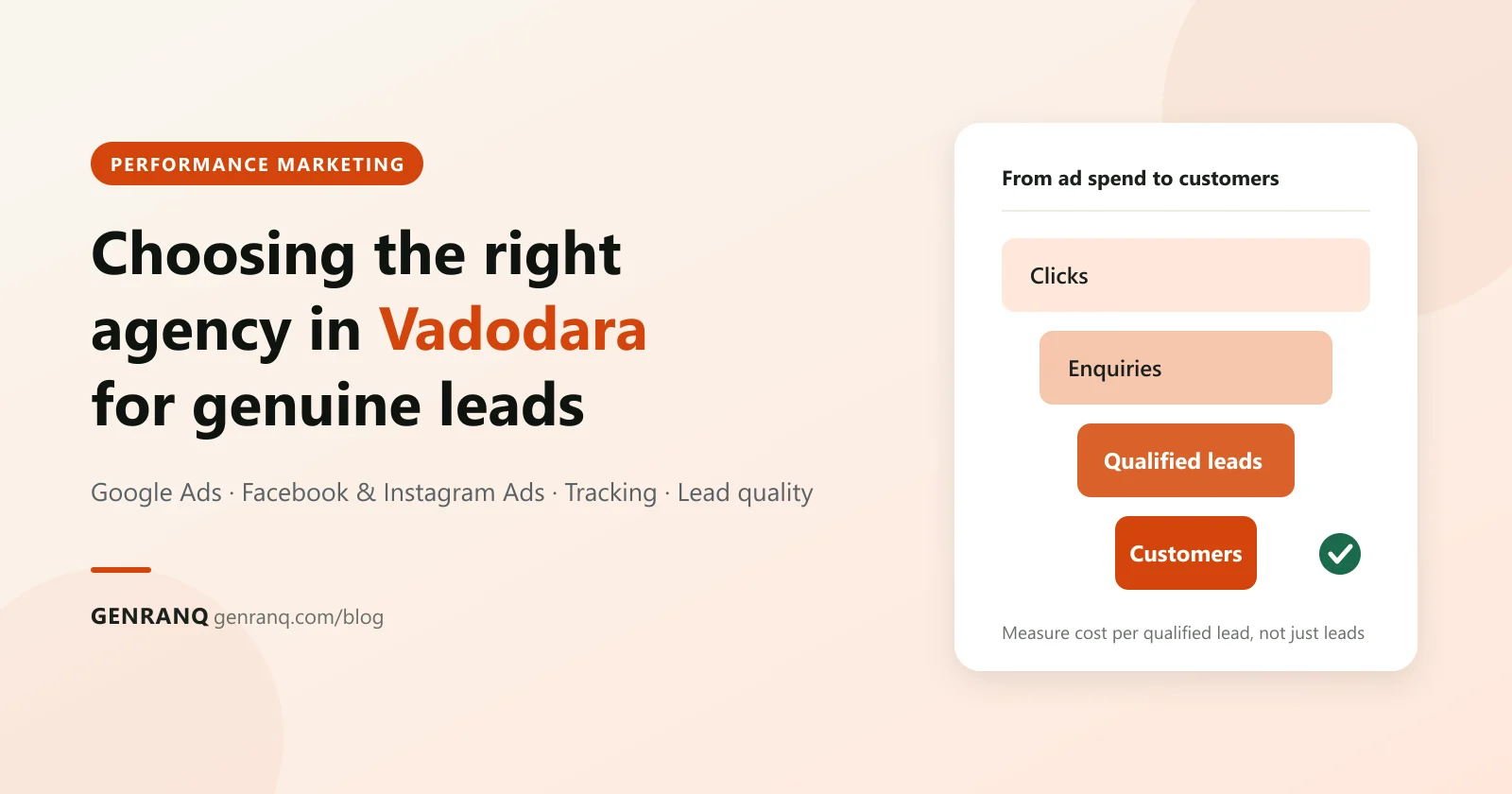
You are investing money in Facebook Ads and Google Ads, receiving enquiries, and expecting your sales team to convert those opportunities into customers. However, the reality can be frustrating. Some weeks bring several enquiries, while others produce very little. Even when leads arrive, people may not answer calls, ask for unrealistic prices, live outside your service area, or show no genuine interest in purchasing. The problem may not be your advertising budget. It could be your targeting, campaign strategy, advertising message, landing page, or lead qualification process.
For businesses in Vadodara, finding the right performance marketing agency requires more than comparing monthly management fees or looking at impressive advertising reports. You need a marketing partner who understands your business, identifies the right audience, measures genuine enquiries, and connects advertising performance with actual sales opportunities. This guide explains how to evaluate an agency, what questions to ask, which metrics matter, and how to avoid spending more money on campaigns that generate enquiries but fail to bring customers.
1. Why Are Your Google and Facebook Ads Not Generating Genuine Enquiries?
Businesses often assume that poor advertising results mean they need a higher budget or better advertisements. However, increasing spending without identifying the underlying problem can make the situation worse. An advertisement might receive hundreds of clicks and generate numerous form submissions without attracting people who can afford, need, or are ready to purchase your products or services. Genuine lead generation starts by understanding where the advertising journey is losing potential customers.
Consider a Vadodara-based business receiving 50 enquiries every month. Its marketing report might show an encouraging number of leads, but the sales team could discover that most enquiries are irrelevant, unanswered, duplicated, or outside the company's service area. The business is paying for activity without receiving equivalent commercial value. To correct this problem, an agency must investigate the complete customer journey rather than simply changing advertisements or increasing the daily advertising budget.
Common Reasons Why Paid Advertising Produces Poor-Quality Leads
Several problems can reduce the quality of enquiries even when campaigns generate consistent traffic.
- Incorrect audience targeting: Your advertisements might reach students, job seekers, competitors, or people who do not have the purchasing requirements for your service.
- Broad geographic targeting: Campaigns may attract enquiries from locations where your business cannot provide services or deliver products economically.
- Misleading advertising messages: An advertisement promising unusually low prices or unrealistic benefits may attract people who are not suitable customers.
- Weak landing pages: Visitors may not understand your pricing, service coverage, product specifications, or next steps after clicking an advertisement.
- Missing lead qualification: Forms that collect only a name and phone number provide limited information for determining whether someone is a potential customer.
- Incorrect conversion tracking: Campaigns may record button clicks, page visits, or other interactions as successful leads even when no genuine enquiry occurs.
- Delayed sales follow-up: Interested prospects may contact another provider when your business takes too long to respond.
The right performance marketing agency should investigate these problems before recommending additional advertising expenditure.
2. Define What a Genuine Business Enquiry Means Before Hiring an Agency
A genuine business enquiry is a contact from someone who matches your target customer profile, has a relevant requirement, falls within your service area, and demonstrates a reasonable possibility of becoming a customer. A completed form alone does not establish lead quality. Your business should agree on specific qualification conditions with the agency before launching campaigns so both teams measure the same commercial outcome.
For example, a company selling industrial equipment in Vadodara may receive enquiries from students researching machinery, individuals requesting employment, small buyers seeking a single component, and procurement managers planning substantial purchases. All four people may complete the same enquiry form, but their commercial value is different. The advertising strategy must identify which enquiries match the company's products, minimum order requirements, budget expectations, and intended customer categories.
How to Distinguish Genuine Leads From Irrelevant Enquiries
Create a lead qualification framework that reflects your sales process. The exact questions depend on your industry, but the following criteria provide a practical starting point.
| Evaluation factor | Genuine enquiry indicator | Warning sign |
|---|---|---|
| Contact details | Valid phone number or email | Incorrect or unreachable details |
| Customer requirement | Clearly describes a relevant need | Unrelated questions |
| Location | Within your service or delivery area | Outside supported locations |
| Budget | Reasonably matches your offering | Unrealistic price expectations |
| Purchase intention | Has a clear requirement or timeline | Only browsing without a defined need |
| Decision-making | Buyer or relevant decision-maker | No purchasing authority or involvement |
| Follow-up | Responds to calls or messages | Repeatedly unreachable |
These factors should become part of your agency's reporting process. A business selling high-value machinery may prioritize purchase requirements and procurement authority, whereas a local home renovation company may focus more on property location, project size, and expected starting date.
Calculate Cost Per Qualified Lead Instead of Only Cost Per Lead
Cost per lead (CPL) measures the advertising expenditure required to generate one recorded enquiry. Cost per qualified lead (CPQL) measures the expenditure required to generate one enquiry that meets your agreed qualification conditions. CPQL is often a more useful decision-making metric because it connects advertising costs with the quality of opportunities reaching your sales team.
Consider this hypothetical campaign:
| Performance measurement | Example result |
|---|---|
| Monthly advertising spend | ₹60,000 |
| Total enquiries generated | 100 |
| Qualified enquiries | 30 |
| Customers acquired | 5 |
| Cost per enquiry | ₹600 |
| Cost per qualified lead | ₹2,000 |
| Advertising spend per acquired customer | ₹12,000 |
Although the campaign generates 100 enquiries, only 30 meet the qualification criteria. The business should investigate the quality and conversion of those 30 opportunities instead of assuming that all 100 submissions represent successful marketing outcomes. The final customer acquisition cost will also include relevant agency fees, creative costs, sales expenses, and other acquisition costs.
Prepare a Lead Quality Scorecard Before Comparing Agencies
Write down your ideal customer, supported locations, budget requirements, and the information your sales team needs before contacting prospects. Share this scorecard with every shortlisted agency so their proposals can be evaluated against the same business objectives. This simple exercise helps prevent an agency from presenting high enquiry volume as evidence of success when those enquiries do not match your actual customers.
Getting enquiries from Google or Facebook Ads, but not customers?
Share your ad account with our Vadodara team. We will check your targeting, search terms, landing page and conversion tracking, and show you where genuine leads are being lost.
3. How to Evaluate a Performance Marketing Agency in Vadodara
Choosing a local performance marketing agency can make communication, campaign discussions, and business meetings easier. However, being located in Vadodara does not automatically establish that an agency understands your industry or can manage profitable advertising campaigns. Evaluate its experience according to the complexity of your business, customer buying journey, advertising requirements, and ability to explain campaign decisions.
For instance, a real estate business, an industrial manufacturer, a healthcare provider, and a local service company need different advertising approaches. A manufacturer may need enquiries from procurement managers and distributors, while a local service business might prioritize calls and WhatsApp conversations from customers within a limited service area. Your shortlisted agency should demonstrate that it can adapt its strategy to these differences rather than offering the same campaign structure to every client.
Check Whether the Agency Understands Your Industry
Ask the agency to explain how it would approach customer acquisition for your particular business. Its answers should cover audience identification, customer research, advertising channels, campaign structure, landing-page requirements, and lead qualification.
Look for practical experience in areas relevant to your industry:
- Local service businesses: Understanding of location-based targeting, service-area restrictions, phone enquiries, and appointment bookings.
- B2B and manufacturing businesses: Understanding of business decision-makers, technical requirements, procurement processes, and longer sales cycles.
- Real estate companies: Understanding of property location, buyer budgets, site visits, project details, and genuine purchase interest.
- Ecommerce businesses: Understanding of product audiences, shopping campaigns, conversion rates, transaction values, and repeat purchases.
- Healthcare and professional services: Understanding of service suitability, enquiry requirements, appointment processes, and applicable advertising restrictions.
An agency should also explain where its existing experience is limited. Honest communication about industry differences is more useful than claiming expertise in every possible business category.
Examine Previous Campaign Work and Case Studies
Ask to see case studies or campaign examples that demonstrate how the agency approached a business problem. A useful case study should explain the original situation, business objective, campaign approach, measurement method, and outcomes that can be substantiated. Pay particular attention to whether results refer to raw leads, qualified leads, booked appointments, actual sales, or advertising revenue.
Do not rely entirely on screenshots displaying impressions, clicks, or low CPL figures. Ask what happened after enquiries entered the sales process and whether the reported results were measured across the same period and business conditions. Where confidentiality prevents the agency from sharing customer information, it should still be able to explain its methodology and provide appropriately anonymized evidence.
Verify Reviews, Communication, and Account Support
Online reviews can help identify patterns in customer experiences, but they cannot independently prove that an agency will deliver suitable results for your company. Look for consistent feedback about communication, reporting transparency, project management, and responsiveness. During the initial discussion, establish who will manage your campaigns and whether that person will also explain performance reports.
Ask for a clear answer to these questions:
- Who will be responsible for managing my advertising accounts?
- Will I communicate directly with the campaign manager?
- How frequently will campaign performance be reviewed?
- Who will investigate poor-quality enquiries?
- How are campaign changes communicated and approved?
- What happens when advertising performance declines?
A dedicated point of contact and a clear reporting schedule can prevent misunderstandings during the engagement.
4. Which Performance Marketing Services Should a Good Agency Provide?
A capable performance marketing agency should offer more than advertising campaign setup. Its work should connect audience research, channel selection, advertising creative, conversion-focused landing pages, tracking, lead qualification, and continuous optimization. Depending on your business model, this may involve Google Ads, Facebook and Instagram advertising, remarketing, landing-page improvements, and CRM integration.
Not every business needs every advertising platform. A Vadodara company selling specialized industrial products may receive more useful enquiries from high-intent Google searches, while a consumer-facing brand may find Meta advertising more suitable for introducing products to potential customers. The agency should explain the reason behind each recommended channel and identify what evidence will determine whether the investment is worthwhile.
Google Ads for Customers Actively Searching for Your Services
Google Ads can help businesses reach people searching for particular products, services, or solutions. For example, a customer searching for an AC repair service in Vadodara may already have an immediate requirement. Search advertising can place a relevant business in front of that customer when the keyword, advertisement, location settings, and landing page match the search intent.
However, selecting relevant keywords is only the beginning. Ask your agency how it will review actual search queries, identify irrelevant traffic, manage negative keywords, organize campaigns, and track genuine conversions. Google's official Search Terms Report documentation explains how advertisers can examine the actual searches that triggered their advertisements and use the information to refine targeting.
Facebook and Instagram Ads for Audience Discovery
Meta advertising can help introduce a product or service to relevant audiences who may not be actively searching for it. Facebook and Instagram campaigns can use different creatives, audience approaches, and advertising messages to generate interest. Their effectiveness depends on the business, the strength of the offer, the audience, and the process used to convert advertising responses into genuine conversations.
An agency should explain how it will distinguish between people who simply interact with an advertisement and people who have a real purchasing requirement. For example, a residential interior design campaign could ask about project location, property type, approximate budget, and project timeline. These questions provide more context for sales representatives than a basic name-and-phone-number submission.
Landing Page Optimization and Conversion Rate Improvement
Your advertisement creates the first interaction, but your landing page influences what visitors do next. A page with unclear service information, slow loading, confusing forms, missing contact details, or weak calls to action can lose interested prospects even when the advertisement reaches the right audience. Your agency should review the landing page alongside campaign performance instead of blaming every poor result on audience targeting.
A useful landing page should clearly explain the service, the intended customer, important benefits, service coverage, and how to enquire. Depending on the business, it may also need product specifications, pricing information, project examples, customer reviews, or FAQs. Every form field should serve a purpose because unnecessary questions can make it harder for genuinely interested people to complete the enquiry.
Remarketing and CRM Integration
Remarketing helps businesses reconnect with eligible audiences who previously interacted with their website or advertisements. It can support longer buying journeys when customers need additional information before making a decision. An agency should explain which audience segments are appropriate, what information can be used lawfully, and how remarketing contributes to the wider customer acquisition strategy.
CRM integration allows advertising enquiries to enter a structured sales process. The business can record lead sources, contact attempts, qualification status, appointments, and eventual sales outcomes. When implemented appropriately, this information can help the marketing team understand which campaigns attract customers rather than simply generating form submissions.
Ask for a Campaign Strategy, Not Just a List of Services
Request a campaign plan that connects each proposed channel with a specific audience and commercial objective. Ask the agency to explain how Google Ads, Meta Ads, landing pages, and CRM tracking will work together, including which activities are necessary before launch. Choose a partner that can explain why each service is relevant rather than recommending every available advertising platform.
5. Which Performance Metrics Should You Expect From Your Agency?
The right performance marketing agency should report results using metrics that explain advertising efficiency and commercial value. Impressions and clicks help describe campaign exposure, but they cannot independently establish whether your business is receiving genuine enquiries. A meaningful report connects advertising spend with qualified leads, sales conversations, appointments, and acquired customers wherever the business can measure those outcomes.
For example, two agencies may generate 100 enquiries for the same monthly budget, but their business value could be very different. One campaign might attract 20 relevant buyers, while another might produce only five. Comparing raw CPL would not reveal the difference. Your reporting system should distinguish between enquiry volume and the quality, progression, and eventual commercial outcome of those enquiries.
Important Performance Marketing KPIs to Monitor
| KPI | What It Measures | Why Your Business Needs It |
|---|---|---|
| Impressions | Number of advertisement displays | Understands campaign visibility |
| Click-through rate (CTR) | Percentage of impressions resulting in clicks | Helps evaluate advertising relevance |
| Cost per click (CPC) | Average advertising cost per click | Measures traffic acquisition cost |
| Cost per lead (CPL) | Spend divided by recorded leads | Measures enquiry generation expense |
| Cost per qualified lead | Spend divided by qualified leads | Measures qualified opportunity costs |
| Conversion rate | Percentage of relevant visitors completing the desired action | Helps assess website and campaign effectiveness |
| Lead-to-customer rate | Customers acquired relative to qualified leads | Connects marketing with sales outcomes |
| Customer acquisition cost (CAC) | Total relevant acquisition costs per new customer | Helps evaluate overall acquisition economics |
| Return on ad spend (ROAS) | Revenue attributed to advertisements relative to ad spend | Measures attributed advertising revenue |
These metrics should be interpreted according to the business model. A company selling low-value products may prioritize transactions and ROAS, while a B2B manufacturer may need to measure qualified opportunities and revenue generated over a longer period. Your agency should identify which metrics are leading indicators and which represent actual business outcomes.
Understand the Difference Between CPL, CPQL, and ROAS
CPL tells you what it costs to generate recorded enquiries, but it does not indicate whether those enquiries are suitable customers. CPQL adds a qualification layer, while lead-to-customer rate explains how successfully qualified opportunities become paying customers. ROAS is relevant when revenue can be reliably attributed to advertising, but it should not be confused with profit because it does not automatically account for product costs, service delivery, salaries, or other expenses.
For a business with a longer sales cycle, a monthly report should show the status of enquiries generated in previous periods as well as new leads. A campaign may generate fewer enquiries initially but attract larger commercial opportunities. Ask your agency to report on the same qualification definitions over time, disclose attribution limitations, and avoid changing measurement rules merely to make performance appear better.
What Should a Monthly Performance Marketing Report Include?
A useful reporting dashboard should give business owners enough information to understand what happened, why it happened, and what will change next.
Your monthly report should normally include:
- Advertising expenditure: Actual spending by platform and campaign, separated from agency management fees.
- Lead generation results: Total enquiries, unique enquiries, invalid submissions, and qualified leads.
- Audience performance: Location, device, demographic or audience breakdowns where available and relevant.
- Campaign performance: Keywords, search queries, advertisements, creative variations, and conversion results.
- Sales feedback: Contactable leads, appointments, qualified opportunities, and customers acquired where tracked.
- Optimization activities: Changes made to targeting, budgets, advertisements, landing pages, and conversion tracking.
- Next-month priorities: Specific experiments, improvements, and business decisions requiring approval.
A dashboard should not simply display attractive charts. Your account manager should be able to explain why results changed and what the next campaign improvements are expected to achieve.
6. How to Verify Conversion Tracking and Lead Management Before Hiring
Conversion tracking is one of the most important capabilities to examine when choosing a performance marketing agency. Without accurate tracking, campaigns may optimize toward actions that do not represent genuine business enquiries. A visitor clicking a WhatsApp button, opening a contact page, or submitting an incomplete form should not automatically be treated as a successful customer acquisition event without understanding what actually happened.
A reliable tracking setup should distinguish meaningful actions, such as successful form submissions, connected calls, qualified enquiries, booked appointments, and purchases. Your agency should also understand how website analytics, advertising conversion tags, and CRM records relate to each other. The objective is to create a trustworthy measurement process that allows advertising decisions to reflect real customer activity.
Check Google Analytics 4 and Form Submission Tracking
Google Analytics 4 (GA4) helps businesses understand user interactions with their websites. Google documents how advertisers can measure specific lead-generation form submissions as key events instead of treating every form interaction as an equivalent business conversion. Read the official Google Analytics guide to measuring key events.
Ask your agency to demonstrate the following:
- Whether successful form submissions are recorded correctly.
- Whether different enquiry forms can be identified separately.
- Whether duplicate conversions are being counted.
- Whether call and WhatsApp interactions are measured appropriately.
- Whether Google Ads conversion actions correspond to genuine business outcomes.
- Whether campaign and landing-page information is preserved when enquiries reach the sales team.
Test every important form and conversion action before launch. A successful test should create the intended tracking event and deliver the enquiry to the correct business destination.
Connect Advertising Data With Actual Sales Results
The advertising platform may know that someone submitted a form, but your sales team knows whether that person answered the call, met the requirements, and purchased the product or service. Connecting these two sources of information can improve campaign decisions because the agency can learn which advertisements generate better commercial opportunities.
Where suitable and properly configured, Google Ads enhanced conversions for leads can help connect offline lead outcomes with advertising interactions using privacy-safe handling of customer information. Google's Enhanced Conversions for Leads documentation explains how this measurement approach works. Your agency should also explain consent, data handling, access permissions, and implementation requirements.
Establish a Clear Lead Follow-Up Process
Advertising cannot complete the sales process by itself. Your internal team must contact enquiries, record outcomes, and communicate lead quality to the agency. If sales representatives receive notifications late or do not maintain proper records, your business may incorrectly conclude that campaigns are ineffective when the underlying problem is actually the follow-up process.
Before launch, agree on a simple workflow:
- Lead received: Every valid enquiry enters your CRM, spreadsheet, or designated lead management system with its source information.
- Lead assigned: A responsible sales representative receives the enquiry and knows when to contact the prospect.
- Contact attempted: The team records calls, messages, and whether the prospect responds.
- Lead qualified: The representative records the requirement, location, budget, and other relevant conditions.
- Sales outcome recorded: The business tracks appointments, quotations, negotiations, lost opportunities, and completed sales.
- Marketing feedback shared: The agency reviews lead quality and uses the feedback to improve audiences, creative, and campaign settings.
A consistent process gives both teams a clearer understanding of what advertising is contributing to business growth.
Request a Tracking Demonstration Before Approving the Campaign
Ask the agency to demonstrate a complete enquiry journey, from clicking an advertisement to receiving a lead notification and recording the enquiry in your reporting system. Test a form, call, and WhatsApp action where applicable. Confirm that access to the accounts, conversion settings, and collected business data will remain available to your company.
7. How to Compare Agency Pricing, Proposals, and Advertising Budgets
Agency fees should be evaluated against the work being delivered, not simply the lowest monthly quotation. Some providers charge a fixed management fee, while others use a percentage of advertising expenditure or a combination of management and project fees. The appropriate arrangement depends on campaign complexity, the number of platforms, creative requirements, landing-page work, reporting, and the level of ongoing optimization.
A lower quotation may exclude important work such as conversion tracking, landing-page improvements, advertisement creative production, CRM integration, or regular campaign analysis. Another proposal may include these services but charge a higher fee. Comparing proposals line by line helps you understand what each agency will actually deliver and whether the commercial arrangement is suitable for your business.
Understand What You Are Paying For
Request a written breakdown of advertising expenditure, management fees, creative production, landing-page work, analytics implementation, and other additional services. Advertisement spend should be clearly distinguished from the agency's professional fee so you know exactly how much money reaches each advertising platform.
| Cost component | What to verify | Important consideration |
|---|---|---|
| Advertising budget | Amount paid to Google or Meta | Actual platform expenditure |
| Management fee | Monthly or project-based agency charge | Scope of campaign management |
| Creative production | Images, videos, copywriting, and revisions | Number and type of deliverables |
| Landing-page development | Design, development, and maintenance | Whether included or separately billed |
| Tracking setup | GA4, Google Ads, and Meta tracking | Initial setup and ongoing maintenance |
| CRM integration | Lead routing and sales data connection | Platform and integration costs |
| Additional services | Reporting, consulting, and other work | Any extra charges or exclusions |
Also establish who owns the advertising accounts, website landing pages, analytics properties, creative files, and customer data. Your business should retain appropriate administrative access and understand what happens to these assets when the agency relationship ends.
Ask What the Agency Will Deliver Every Month
A proposal should clearly identify the activities included in the engagement. This makes it easier to hold the provider accountable for the agreed work without confusing completed tasks with business outcomes.
Request written details covering:
- Number of advertising platforms and campaigns managed.
- Advertising research, strategy, and setup responsibilities.
- Creative and copywriting deliverables.
- Campaign optimization and review frequency.
- Conversion tracking and analytics responsibilities.
- Reporting format and meeting schedule.
- Landing-page and technical support requirements.
- Contract duration, cancellation terms, and account handover.
A good proposal should also explain what the agency expects from your business, including access to advertising accounts, website resources, product information, sales feedback, and timely approval of campaign materials.
Set Realistic Expectations About Advertising Results
No responsible agency can establish a guaranteed number of customers without understanding the market, competition, product, pricing, website, budget, and sales process. The agency can propose a measurement framework, explain its methodology, and commit to the agreed scope of work, but the final business outcome depends on multiple factors outside its direct control.
During the initial engagement, agree on what success means and how long the evaluation period should be. Early campaign data can identify problems with targeting, search intent, creative, or tracking, but meaningful conclusions may require enough qualified enquiries and sales feedback. Avoid committing to large budget increases based on a few successful days or an unexplained performance projection.
8. Red Flags to Avoid When Selecting a Performance Marketing Agency in Vadodara
An agency's sales presentation may look impressive, but the actual working relationship depends on transparency, technical capability, and accountability. Businesses should examine how providers explain previous performance, manage advertising accounts, handle customer information, and respond when campaigns generate poor-quality enquiries. A professional agency should be comfortable discussing risks, limitations, and the work required to improve performance.
For example, an agency might promise 200 leads every month without asking about your product pricing, target audience, sales capacity, or service area. Such a projection is not a reliable strategy. Your business needs a realistic assessment of the customer acquisition process, including potential obstacles that could prevent enquiries from becoming sales. The following warning signs deserve particular attention before signing an agreement.
Warning Signs That Should Make You Reconsider an Agency
Watch out for these common problems when evaluating potential providers:
- Guaranteed leads or sales: Be cautious when an agency promises a fixed number of customers or a guaranteed return without understanding your business conditions.
- No access to advertising accounts: You should not have to depend entirely on an agency's screenshots to understand your advertising expenditure and campaign activity.
- Unclear advertising expenditure: Avoid arrangements where platform spending and management fees are mixed without proper accounting.
- No conversion tracking explanation: An agency should be able to explain what it counts as a lead and how it verifies that the action occurred.
- Only vanity metrics: Reports focused exclusively on likes, impressions, and clicks do not provide sufficient evidence of commercial performance.
- No industry understanding: Generic campaigns may fail to address the actual buying requirements of your target customers.
- No sales feedback process: If the agency never asks whether enquiries are relevant or converting, it may continue optimizing for the wrong outcome.
- Unclear contract conditions: Missing details about fees, ownership, responsibilities, and termination can create problems later.
An additional warning sign is when the agency immediately recommends increasing your budget without examining existing campaign data. More expenditure cannot automatically correct an irrelevant audience, poor offer, weak landing page, or broken tracking setup.
A Practical 30-Day Evaluation Framework for Your New Agency
A structured initial evaluation can help both teams understand the advertising account before making significant changes. The following framework is a suggested management approach, not a guarantee that every business will achieve a specific result within 30 days.
Week 1: Business and Campaign Assessment
The agency should understand your products, ideal customers, sales process, service locations, advertising history, and current lead quality. It should also examine existing advertisements, campaign targeting, tracking configuration, landing pages, and available sales data. At the end of this stage, you should have a clear list of problems and proposed improvements.
Week 2: Campaign Strategy and Setup
The agency should prepare the campaign structure, audience approach, keyword strategy, advertisement messages, and landing-page requirements. Conversion tracking and lead routing should be tested before campaigns are approved. You should also agree on qualification criteria and reporting definitions so campaign results can be evaluated consistently.
Week 3: Monitoring and Initial Optimization
Review early search queries, advertisement engagement, conversion events, audience response, and the first enquiries received. Check whether people are asking about your actual products or services and whether their locations and requirements match your business. Use these observations to identify changes that need testing.
Week 4: Lead Quality and Business Review
Compare advertising expenditure against unique enquiries and qualified opportunities. Ask the sales team to explain which leads were contacted, which progressed, and why others were rejected. The agency should present what was learned, what was changed, and which experiments deserve further attention. Use this information to decide whether the account is ready for continued optimization or needs additional correction.
Start With a Measurable Campaign Pilot
Agree on a manageable initial scope, clearly documented responsibilities, and a reporting schedule before committing to a larger advertising budget. Review campaign performance alongside actual sales feedback, rather than judging the agency only by the number of enquiries generated. A controlled evaluation makes it easier to understand whether the working relationship is adding value to your business.
Frequently Asked Questions About Performance Marketing Agencies in Vadodara
1. How Do I Find the Best Performance Marketing Agency in Vadodara?
Start by identifying agencies with relevant experience in your industry and the advertising channels your business needs. Review their campaign examples, tracking capabilities, reporting process, account ownership policies, and communication standards. During your meetings, explain your customer requirements and ask how they would improve lead quality. Compare proposals based on actual deliverables and their approach to qualified enquiries rather than choosing an agency solely because it has the lowest management fee.
2. How Much Does a Performance Marketing Agency Charge in Vadodara?
The cost depends on the agency's management fee, advertising platforms, number of campaigns, creative requirements, landing-page work, and tracking responsibilities. Your monthly investment should distinguish the amount paid directly to Google or Meta from the agency's professional charges. Ask for a written quotation covering setup, management, creative production, reporting, and additional services. There is no single suitable price for every business because campaign complexity and resource requirements vary significantly.
3. Can Google Ads and Facebook Ads Generate Genuine Business Enquiries?
Yes, both platforms can support business lead generation, but they serve different advertising purposes. Google Ads can reach customers actively searching for specific products or services, while Facebook and Instagram campaigns can introduce your offering to relevant audiences. The quality of enquiries depends on the audience, advertising message, offer, landing page, tracking, and qualification process. Your business should evaluate each platform according to qualified opportunities and sales outcomes rather than enquiry volume alone.
4. Why Am I Receiving Leads That Never Answer My Calls?
Unanswered enquiries can result from incorrect contact information, low purchase intent, unclear advertising messages, accidental submissions, or delayed follow-up. Your sales team should record contact attempts and identify patterns in the unsuccessful enquiries. Share this information with your agency so it can review the advertisements, form questions, and audience targeting. Where possible, use additional qualification questions and clear communication about what happens after a person submits an enquiry.
5. How Can I Improve Lead Quality From Facebook and Instagram Ads?
Start by making the advertising message more specific about your product, service, location, and intended customer. Review whether the campaign attracts the correct audience and whether the enquiry form asks useful qualification questions. Consider collecting relevant information about customer requirements, budget, location, and purchase timeline. The sales team should also provide regular feedback about enquiry quality so your agency can test improvements instead of optimizing exclusively for low-cost form submissions.
6. What Is the Difference Between Cost Per Lead and Cost Per Qualified Lead?
Cost per lead measures how much advertising expenditure is required to generate a recorded enquiry. Cost per qualified lead measures how much is spent generating enquiries that meet your agreed customer requirements. For example, a campaign may generate 100 enquiries but only 30 qualified opportunities. The business should evaluate the cost of acquiring those 30 opportunities alongside their progression into sales, because cheap enquiries are not necessarily valuable business opportunities.
7. How Long Does It Take for a Performance Marketing Campaign to Show Results?
Campaigns can begin collecting engagement and enquiry data soon after launch, but reliable business conclusions may require additional time and sufficient conversion volume. The evaluation period depends on your industry, competition, customer buying cycle, budget, and sales follow-up. An agency should establish realistic review milestones, explain early campaign findings, and identify what needs improvement. Avoid judging long sales-cycle campaigns entirely on the basis of their first few days of advertising activity.
8. Should I Hire a Local Vadodara Agency or a Digital Marketing Agency From Another City?
A local Vadodara agency may provide convenient meetings, regional business understanding, and easier coordination with your sales team. However, an agency from another city can also deliver effective campaigns if it has the necessary expertise, communication processes, and understanding of your target market. Compare the actual campaign team, relevant industry experience, reporting standards, and account management model. Choose based on the quality of its work rather than office location alone.
Conclusion: Choose an Agency That Understands Business Results, Not Just Advertising Numbers
Finding the right performance marketing agency in Vadodara starts with understanding what your business actually needs from advertising. A higher number of enquiries does not automatically mean higher revenue, and a low cost per lead does not prove that your campaign is profitable. Before hiring an agency, evaluate its industry knowledge, campaign strategy, Google Ads and Meta Ads capabilities, conversion tracking, landing-page approach, reporting transparency, and ability to incorporate sales feedback. Most importantly, agree on a clear definition of a genuine enquiry and make qualified lead generation a central part of your marketing evaluation.
Your next step should be to review your existing advertising accounts, identify where enquiries are becoming irrelevant or getting lost, and document the improvements your business needs. Speak with shortlisted agencies, request a practical campaign assessment, and compare their recommendations against your customer acquisition objectives. The right partner should help you understand where your marketing budget is going, which campaigns attract suitable customers, and what needs to improve to turn advertising expenditure into measurable business opportunities.
See exactly where ChatGPT, Gemini & Perplexity mention your brand
Our senior search architects forensic-test 50+ commercial buying queries to uncover your brand's true generative visibility against top competitors.